

Your Reflux Was Never an Acid Problem
Top Gastroenterologist Breaks Ranks: “Your Reflux Was Never an Acid Problem, and the Pills Were Never Going to Fix It.”

Dear Friend Who Is Tired of Living on Antacids,
If you are reading this with acid sitting in your throat right now.
If you wake at two in the morning, propped on pillows, and it comes up anyway.
If you have started reading menus by what will punish you later instead of what you want.
Then what I am about to tell you may change how you understand your reflux for good.
But I have to warn you first.
What you are about to read will probably make you angry.
Because the explanation I am going to give you has been sitting in plain sight for forty years, and the system that treats reflux has had every reason to keep quiet about it.
Not because it is wrong.
Because there is no expensive drug at the end of it.
And when an industry built on a pill that people refill for the rest of their lives runs into an explanation that does not need that pill, it does not celebrate.
It looks away.
My name is Dr. Jonathan Pierce.
I am a gastroenterologist with twenty-four years of practice.
I have performed more than nine thousand endoscopies.
I trained residents in digestive medicine for over a decade.
And until about two years ago, I believed almost everything I had been taught about reflux.
I prescribed the same acid blockers everyone prescribes.
I told patients the same thing every gastroenterologist tells them. Lose some weight, raise the head of the bed, avoid your triggers, and if it keeps up, we will increase the dose.
I believed I was helping.
Then it happened in my own house, to the person I love most, and I could not look away from it any longer.
The Night Everything Changed

My wife is named Ellen.
For thirty years she was the one who cooked in our house.
Sunday dinners for the whole family. The smell of garlic when I walked in the door. Food was how she loved people.
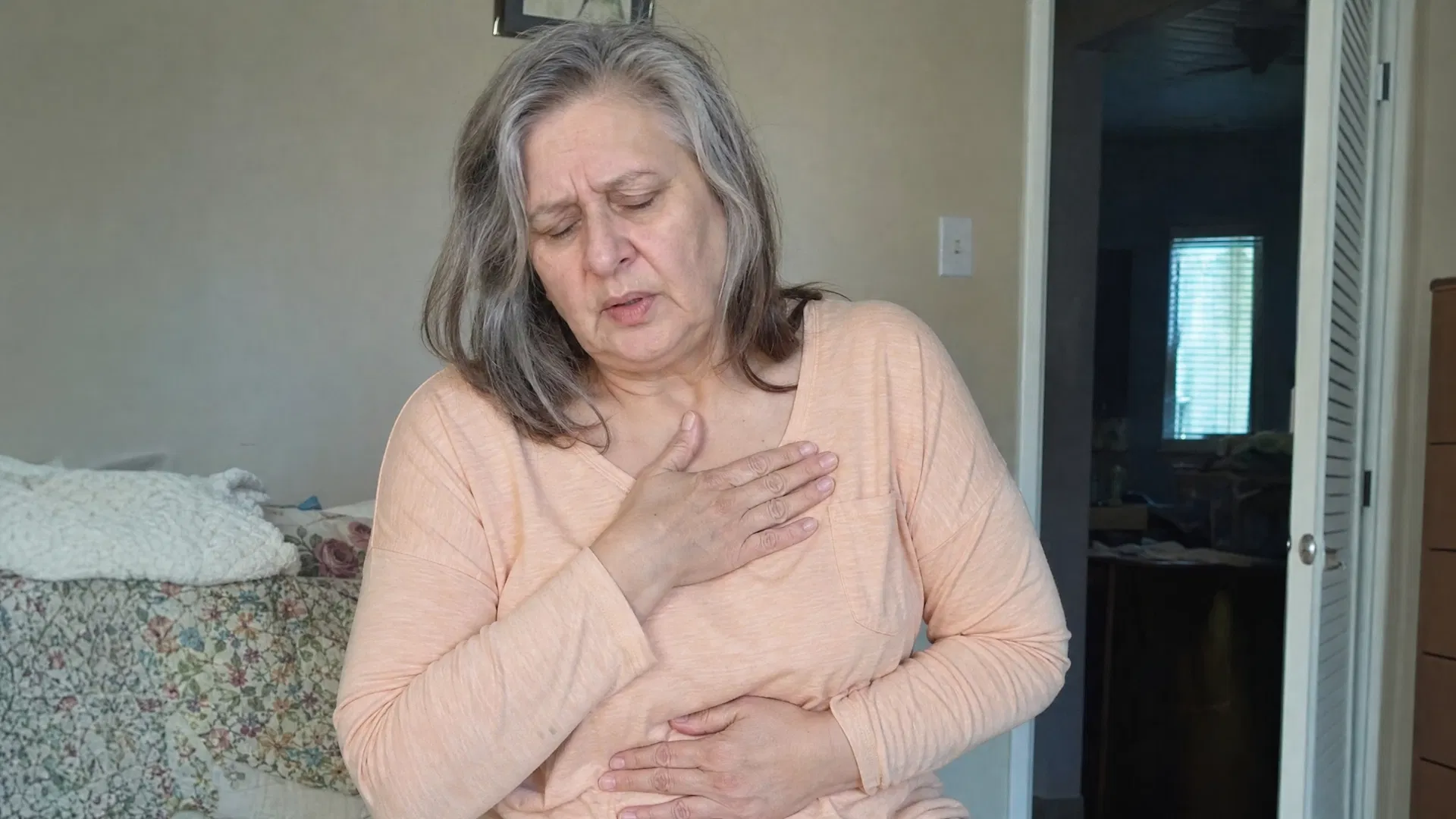
Her reflux started quietly, the way it does for most people.
A little burning after dinner. Then antacids in the kitchen drawer. Then a prescription from me, because I was the doctor in the family and that is what we do.
For a few years it was, in her words, manageable.
Then one night I woke up to a sound I will never forget.
Ellen was sitting upright in the dark, gripping the edge of the mattress, fighting to breathe.
Acid had come up while she slept and gone down the wrong way, and for a few seconds her airway had closed.
She was fine. It passed.
But she was shaking, and so was I.
And here is the part that broke something in me.
I am a gut specialist.
I had been writing her prescriptions for years.
And the pills had never once stopped that from happening.
They had lowered the burn enough that we both told ourselves it was under control.
A few weeks later I scoped her myself, and I saw the early tissue changes that I have spent my career warning other people’s families about.
The acid had been quietly working the whole time.
The drug had changed how much it hurt.
It had done nothing about the fact that it kept happening.
That night I stopped being a doctor who repeats what he was taught.
I started asking the one question nobody had asked.
What part of Ellen’s body was actually supposed to be keeping the acid down, and why was no pill in the world fixing it.
What I Found Made Me Angry

For months I read everything I could find.
I went back through the reflux research from the last forty years, the studies that never make it into a ten-minute appointment.
And what I found made me angry.
The treatment of reflux in this country is built around the wrong target.
Almost everything we hand people, the antacids, the H2 blockers, the proton pump inhibitors, does one thing. It changes the acid.
Less acid, weaker acid, no acid.
But the reason acid is reaching your esophagus in the first place has very little to do with how much of it you make.
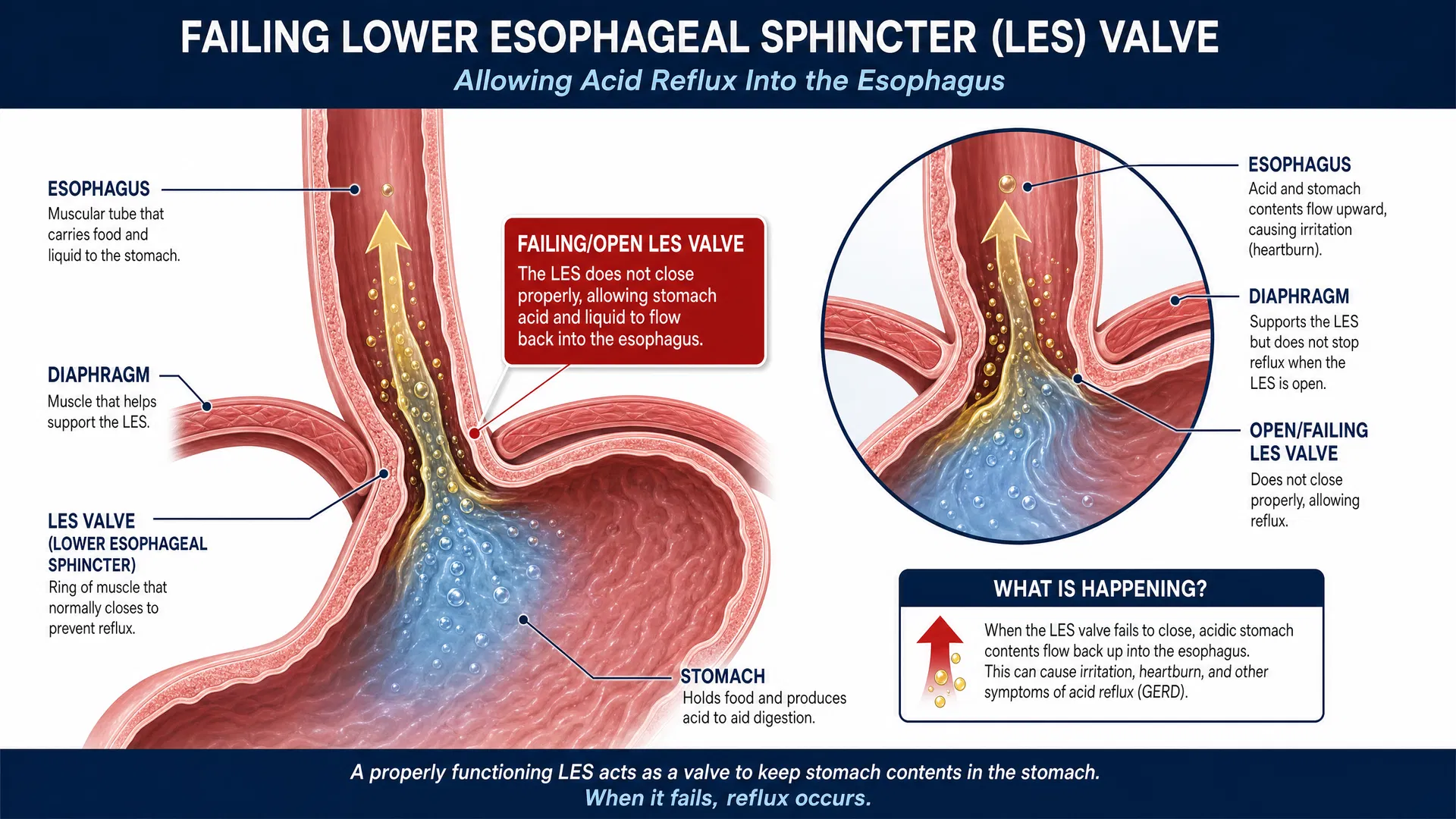
It has to do with a valve that is no longer closing.
And no pill closes a valve.
Here is what almost no one tells you about the pills themselves:
- The proton pump inhibitors, the Prilosecs and Nexiums of the world, were cleared for short courses of roughly eight weeks. Millions of people have now taken them for ten and twenty years.
- When people try to stop, many get a surge of acid worse than what they started with, because the body has adjusted to the drug. That rebound keeps people on it, which is very good for everyone except the patient.
- Your scope can look fine while you still suffer every day, because the scope is looking at the lining, not measuring the valve.
You cannot patent a valve.
There is no molecule to own, no prescription to refill every month for the rest of someone’s life.
So the money went where the patents were, and the simplest explanation for your reflux got left out of the conversation.
That is not a theory about villains in a boardroom.
It is just what happens when the only tool a system gets paid for is a pill.
Your Reflux Isn’t an Acid Problem. It’s a Valve Problem.
Let me explain it the way I wish someone had explained it to Ellen.
At the top of your stomach, where it meets your esophagus, there is a ring of muscle called the lower esophageal sphincter.
It is a valve.
A door that opens when you swallow and is supposed to seal shut the rest of the time.
Think of it like a door on a worn hinge.
When you are young, it closes cleanly every time.
After years of use, after age, after pressure from weight or a large meal, after a section of the stomach slips up through the diaphragm the way it does in so many people over fifty, that door stops seating properly.
Every reflux episode stretches it a little more.
The looser it gets, the more it leaks, and the more it leaks, the looser it gets.
That is the loop you are actually stuck in.
And there is one more piece that explains your worst moments.
After you eat, a thin layer of unbuffered acid forms and floats at the very top of your stomach, right under that valve. Researchers call it the acid pocket.
In a person whose valve seals, it stays put.
In a person whose valve does not, that pocket is the first thing to come back up, which is exactly why your reflux is worst right after a meal and worst again the moment you lie flat.
The medical world has known about this for a long time.
Imaging studies have watched that acid pocket sit under the valve, and watched a simple physical barrier move into place over it and push it back down below the diaphragm.
But there is no money in a barrier you can buy once.
So you were handed a pill that lowers the acid, and the door kept swinging open.
The Three Things That Have to Happen
Once I understood the valve, the answer became obvious, and it had three parts.
By the time most people get to me, the reflux has been going on for years, and it has done two kinds of harm. It keeps happening, because the valve leaks, and it has left damage behind, because acid and an enzyme called pepsin have been reaching tissue that was never built to hold them.
So to actually get ahead of reflux, three things have to happen at once.
1. SHIELD.
Put a physical barrier over the acid pocket, where the valve is failing, so the acid stops reaching the esophagus in the first place.
2. REPAIR.
Rebuild the worn, irritated lining that years of reflux have thinned, because a barrier alone cannot heal tissue.
3. CALM.
Take the pressure off the valve from below, by helping the stomach empty instead of sitting full and pushing the door open.
Miss any one of these and you are back where you started.
A barrier with no repair leaves the damage.
Repair with no barrier gets undone by the next meal.
And neither lasts if the stomach keeps pushing the valve open.
This is why a single acid pill was never enough.
It was aimed at the acid, and it did none of these three things.
When You Step Outside the Protocol
When I started telling colleagues what I was seeing, the reaction surprised me.
It was not curiosity.
It was discomfort.
One senior physician I have known for years told me, in a friendly way, to be careful. That patients need real treatment. That I should not go around undermining established protocols.
What he meant was simpler than that.
The protocol is the pill.
The pill is what the appointment is built around, what the system bills for, what everyone is comfortable with.
Pointing at the valve, and at a barrier that sits against it, is not the default, and stepping outside the default makes people nervous.
I understood then that this was never going to come from inside the system.
So I partnered with a team that formulated it the right way, into something a person could take at home, after dinner, without a prescription.
Introducing MendMD Gut Barrier Repair
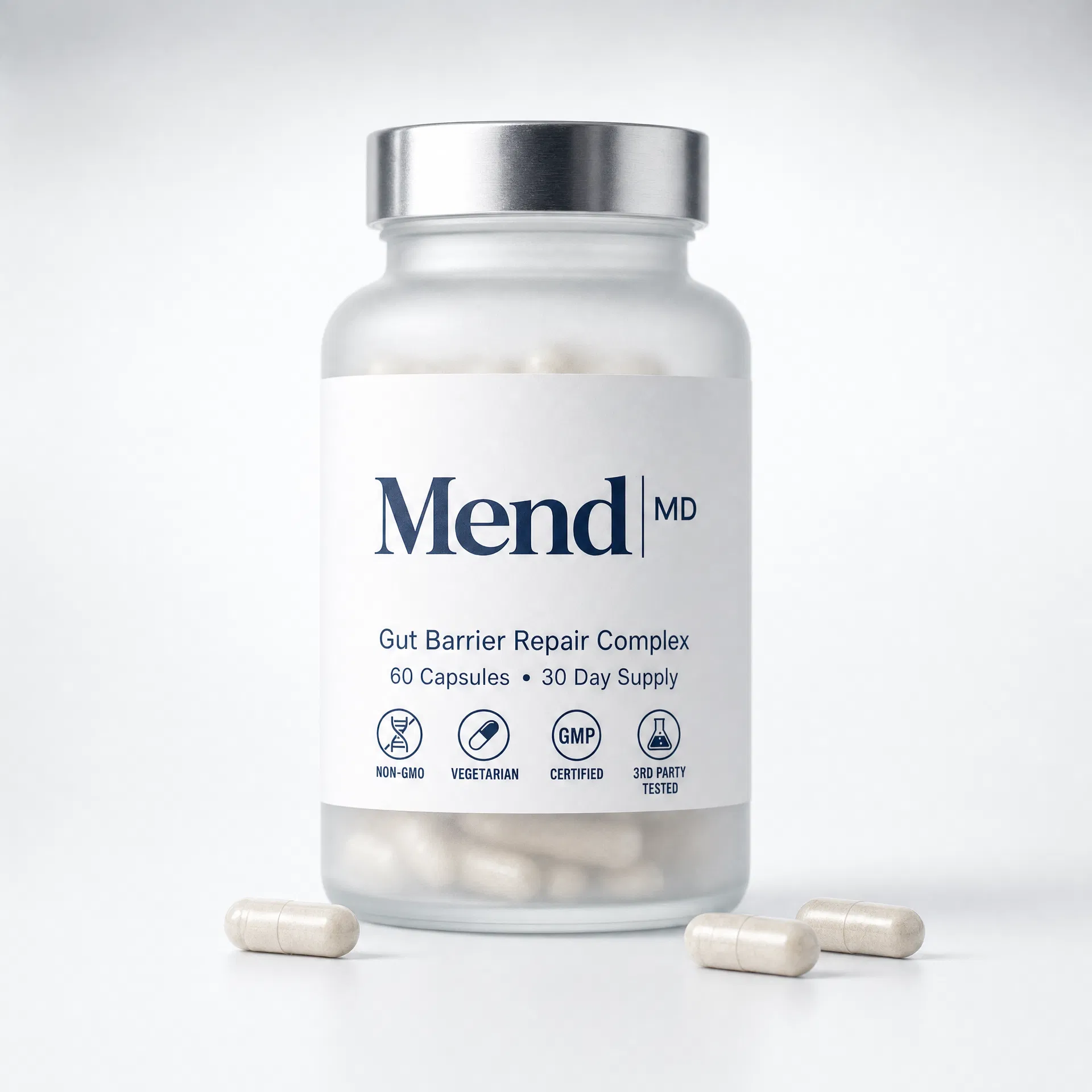
It is called MendMD Gut Barrier Repair.
It is the first thing I have found that does all three jobs in one capsule you take after your largest meal. Each bottle contains 60 capsules for a 30-day supply, is third-party tested, non-GMO, and vegetarian.
Here is how its six ingredients map onto the three steps.
To shield:
Sodium alginate, a fiber from brown seaweed, and calcium carbonate react with the acid and release tiny bubbles of carbon dioxide. Sodium bicarbonate speeds that reaction up. The bubbles get trapped in the gel, the whole thing becomes buoyant, and it floats to the top of your stomach contents and settles right over the acid pocket, exactly where the valve is failing. When pressure builds, the raft takes it. When you lie down, it stays in place.
To repair:
Zinc-L-carnosine, used in Japan for over twenty years to support the stomach lining, binds to irritated tissue and supports its repair. DGL, a form of licorice, helps your body rebuild the protective mucus layer that years of acid suppression tend to thin.
To calm:
Ginger extract helps the stomach empty faster, so food moves through instead of sitting and forcing the valve open.
Six ingredients. Every dose printed on the label. No proprietary blend.
A mechanical problem, met with a mechanical answer, plus the repair that years of reflux made necessary.
What Happens When You Take It

Reflux that took years to build does not undo itself in a weekend, and I will not pretend otherwise.
But the shield is physical, and it forms fast.
In imaging studies the raft settles over the acid pocket within about thirty minutes of a dose.
Here is the arc most people can expect.
Days 1 to 3.
The barrier goes to work after each dose. The burning after meals tends to feel calmer.
Weeks 1 to 2.
The nights start to settle. Less waking, fewer pillows.
Weeks 3 to 4.
The focus shifts to the lining. Bloating and that constant post-meal pressure often ease.
Months 2 to 3.
The goal stops being relief and starts being normal. Fewer calculations at dinner, and a stomach you forget to think about.
This is why I tell people to give it a full reset, not a single bottle.
What the Research Shows
Alginate raft therapy improved the odds of reflux symptom resolution more than fourfold versus placebo or antacids, in a meta-analysis of randomized trials. Leiman et al., 2017.
Sodium alginate held its own against omeprazole for symptom control in a head-to-head randomized trial. Chiu et al., 2013.
Added on top of a PPI, alginate more than doubled complete heartburn resolution versus the PPI alone, 56.7 percent versus 25.7 percent. Manabe et al., 2012.
Imaging studies have watched the raft form and localize over the acid pocket within thirty minutes. Rohof et al., 2013, and Sweis et al., 2013.
Results reflect published studies of alginate therapy and the individual ingredients. Doses and forms may differ. Individual results vary. Not intended to diagnose, treat, cure, or prevent any disease.
These are not my user testimonials.
These are published trials of the approach itself, the kind of research that never makes it into a ten-minute appointment.
“I was on Nexium for eleven years and still woke up choking most nights. A few weeks on this and I am sleeping flat for the first time in a decade.”
Margaret K., Verified Customer
“I am a cook. Reflux was taking the one thing I love. Two months in, I am tasting my own food again without paying for it that night.”
Rafael G., Verified Customer
All testimonials are illustrative drafts in the customer voice. Replace with real, consented reviews before publish.
Testimonial results are individual and may vary. Not intended to diagnose, treat, cure, or prevent any disease.
What Reflux Really Costs You
Let me show you what a worn valve actually costs when you only treat the acid.
The prescription route:
A daily acid drug, year after year, plus the office visits to keep renewing it. Most people are looking at hundreds of dollars a year, for as long as they live, for a drug that was meant for eight weeks.
The specialist route:
A consultation, a scope, sometimes a second opinion. Often a few thousand dollars, frequently ending with a stronger version of the same pill.
The surgery route:
Wrapping the stomach around the esophagus to do mechanically what the valve no longer does. Tens of thousands of dollars, with real recovery and a real failure rate.
Notice something.
The surgery is mechanical.
The surgeons already agree the problem is mechanical. They just reach for a knife instead of a barrier.
Today’s Reader Price
A formula like this could reasonably sit beside any premium gut supplement on the shelf.
The regular price is 69.99 dollars a bottle.
For readers of this page, right now:
A single bottle is 39.99 dollars.
The three-bottle reset, the one I tell people to start with so they get the full arc, works out to 33.33 dollars a bottle, with free shipping.
Two capsules after your largest meal.
That is less than many people spend on a single month of the pills that never closed the valve.
My 60-Day Guarantee
I understand if you have been burned before.
So here is the arrangement.
Try MendMD for sixty days.
Take it after your largest meal, every day.
If you do not reach a morning where you realize you have stopped thinking about your reflux, you email the company at support@getmendmd.com and you get every dollar back.
No forms. No store credit. No questions.
The risk sits with the company, not with you.
Why I Am Telling You This
You are at a fork.
Path one. Keep aiming at the acid. Keep refilling the pill that was built for eight weeks. Keep sleeping propped up. Keep reading menus by what will hurt later. Keep treating the splash and ignoring the leak.
Path two. Try the thing that was built for the valve. Shield the acid pocket, repair the lining, calm the pressure, and give it the full reset.
I watched the woman I love spend years on path one while the damage quietly continued.
I will not tell you what to do.
I will only tell you that the explanation you were never given is the reason nothing has worked, and that there is finally something aimed at the right place.
What to Do Next
- Tap the button below that says Check Availability.
- Choose your supply. Most people take the three-bottle reset so they get the full arc, and shipping is free.
- Enter your shipping details.
- Take two capsules after your largest meal the day it arrives.
- Give it the sixty days. The guarantee is there so you can.
Please do not close this page telling yourself you will order later.
Later is another night propped on pillows.
Later is another meal you ate around instead of enjoyed.
Your valve has waited long enough.
With respect,
Dr. Jonathan Pierce, MD
P.S.
Ellen cooks Sunday dinner again. She also eats it now, sitting down, without rehearsing how the night will go. That is the whole reason this exists.
P.P.S.
MendMD is third-party tested, made in a GMP facility, non-GMO, and vegetarian. Six ingredients, every dose on the label. We did this the honest way.
P.P.P.S.
The reader price on this page is tied to the current sale. When it ends, it goes back to the regular price. If the button below still says available, you are still in time.
This is an advertisement and not an actual news article, blog, or consumer protection update. The information here is not specific medical advice and is not a substitute for professional diagnosis or treatment. These statements have not been evaluated by the Food and Drug Administration. This product is not intended to diagnose, treat, cure, or prevent any disease. Consult your healthcare provider before starting any supplement, especially if you are pregnant, nursing, or taking prescription medication, including PPIs. The story depicted is fictional. The narrator is a composite. Results in the testimonials may not be typical and individual results vary. The owner of this site has a material connection to the seller and is compensated for sales of the product. This page is not part of, or endorsed by, Facebook or Meta. MendMD is third-party tested, non-GMO, vegetarian, and made in a GMP-certified facility.